
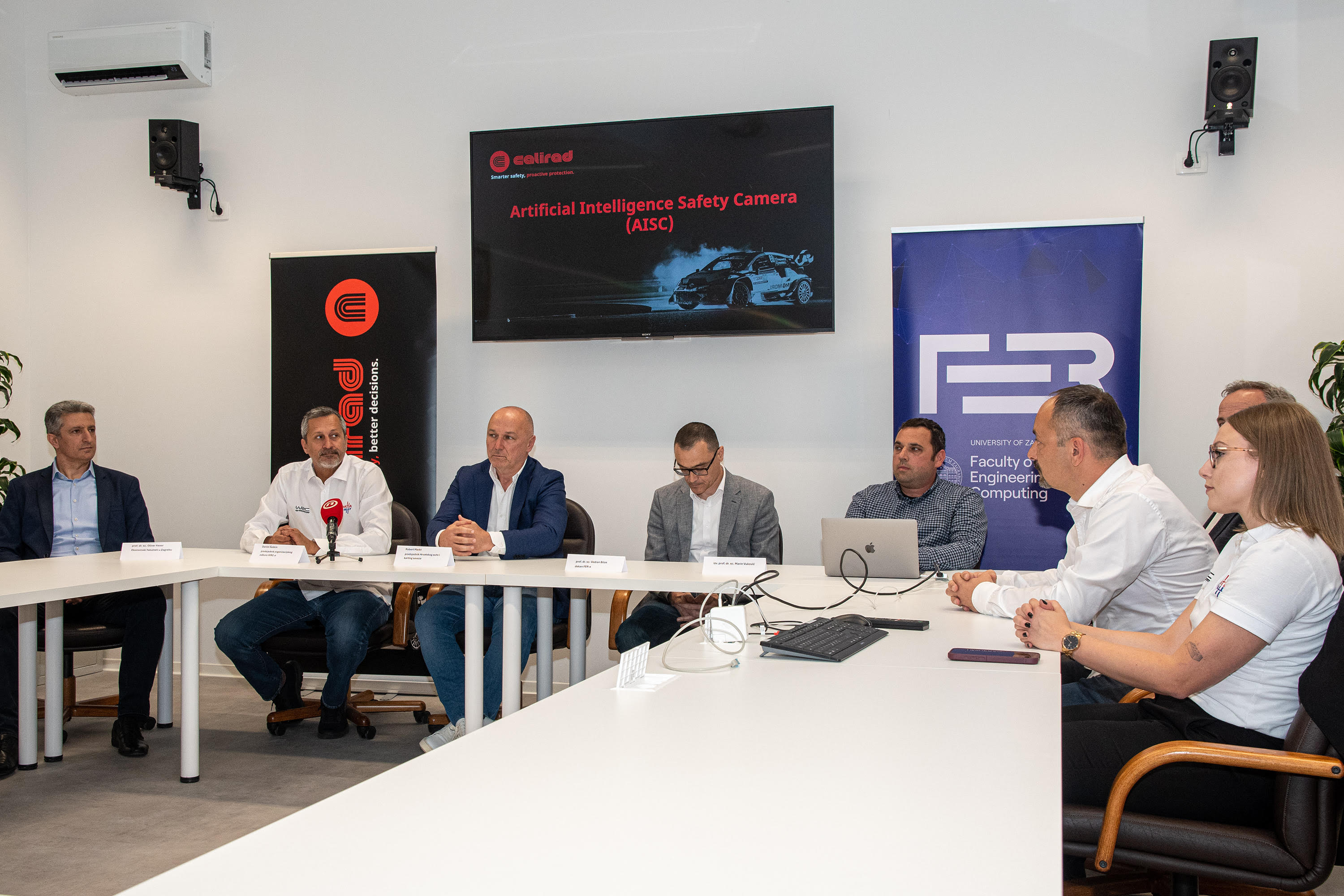
At the Faculty of Electrical Engineering and Computing (FER) of the University of Zagreb, the Calirad AISC – an advanced system for detecting spectators in high-risk areas along motorsport tracks – was presented with the support of the Croatia Rally organizers and the Croatian Automobile and Karting Federation. The system was developed by the company Calirad d.o.o. in cooperation with the Fédération Internationale de l’Automobile (FIA).
This is a Croatian innovation – a system that uses cameras mounted on competition vehicles and machine learning methods to recognize spectators positioned in potentially dangerous zones along roads or tracks where motorsport events are held. The system enables timely alerts to safety services and potential intervention, significantly increasing the safety of both the audience and competitors. It has already been implemented in several races across Europe and globally.
“Our vision was to develop a tool that primarily enhances safety but also provides organizers with insight into spectator distribution, planning, and marketing. We believe this system has the potential to become an industry standard. The FIA has already recognized its value, and we will continue to develop and expand it,” said Dr. Marin Vuković, Associate Professor at FER and co-founder of Calirad, during the presentation.
“FER is committed to the technological development of Croatia and the creation of innovations that address complex challenges. In this process, it is extremely important to encourage students, researchers, and professors to think and act entrepreneurially. Calirad is an excellent example of how scientific knowledge and research can be transformed into globally relevant technology with significant societal impact,” said the Dean of FER, Prof. Dr. Vedran Bilas.
In addition to Professor Vuković, the innovation was developed with the contribution of Juraj Peršić, a postdoctoral researcher and external associate at FER’s Laboratory for Autonomous Mobile Robotics (LAMOR), whose experience in camera calibration significantly contributed to the final solution. In 2023, the Calirad system also went through the Nuqleus startup program within the Nikola Tesla Innovation Center at FER. This process helped further develop the idea and identify new potential areas of application for this advanced system.
Calirad operates on the principle of so-called edge computing, where the detection of dangerous situations takes place directly within the vehicle, without the need for a constant internet connection – which is crucial for use in remote and hard-to-reach areas. Images with detected risks are sent to a central system, i.e., the cloud, where safety personnel analyze them and make decisions on further actions, including possible temporary race suspensions.
“The goal of this system is to save lives. Spectators often don’t realize how quickly they can find themselves in a danger zone, and Calirad’s technology allows us to recognize and prevent potential tragedies in time. As organizers of world and European rally races in Croatia, we are extremely proud that a Croatian team is behind this important global safety project. This once again confirms the strength of local expertise, innovation, and organization, as well as the contribution of sports events to promoting Croatia and strengthening the national economy. We are particularly pleased that this system will also be used at the European Rally Championship event taking place in Croatia this fall,” said Daniel Šaškin, President of the Croatia Rally Organizing Committee.
In addition to the system’s developers, the presentation was also attended by Robert Markt, President of the Croatian Automobile and Karting Federation, and Prof. Dr. Oliver Kesar from the Faculty of Economics and Business at the University of Zagreb, who emphasized the importance of connecting science, sports, and industry in creating innovations with measurable societal impact.
Calirad is a prime example of how Croatian science and technological innovation can set new global safety standards while also opening the door to broader application in other sectors where real-time detection and monitoring are key challenges.